Nonocross
Gimica GmbHPuzzle
3.292.00 Reviews
- Version
- 1.1.0
- Installs
- 100.00K
- Age Rating
- Everyone
Screenshots

Our Review of Nonocross
 Analysis by Appyee
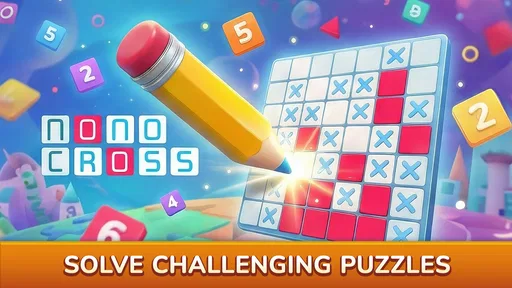
I spent time with Nonocross as a compact puzzle game built around Nonogram logic: read the number clues, fill the correct squares, and gradually uncover a pixel-art image. That basic loop is familiar, but it still has a nice rhythm when the puzzle gives you just enough information to make a careful deduction. I found it most appealing in short, quiet sessions rather than as a game I would play continuously for hours.
It is a free game from Gimica GmbH, listed for Everyone and available on Android devices running version 7.0 or later. The current release is 1.1.0, and the game has passed the 100K-install mark. Its average rating sits at 3.2 from more than 400 ratings, which matches my overall impression: the central idea is easy to understand and potentially relaxing, but the experience will depend heavily on how comfortable you are with small visual grids and repeated clue reading.
How Nonocross feels to use in different situations
I find Nonogram puzzles work best when the setting leaves me enough attention to follow each clue, so I’d choose a calm break over a rushed moment. The same grid can feel pleasantly absorbing at home and fiddly on a moving commute; in the next section, I’ll look at how those everyday conditions change the experience.
Readability and navigation come before puzzle difficulty
The first thing I look for in a Nonogram game is not whether the puzzles are clever. It is whether I can read the clues without fighting the interface. Every move depends on seeing the numbers beside each row and above each column, then comparing them with the available spaces. If those clues are cramped, low-contrast, or visually crowded, even a well-designed puzzle becomes tiring.
Nonocross presents a very direct concept, which helps new players. The short description calls it “Nonocross,” while the fuller store summary explains that the aim is to solve Nonogram puzzles and reveal hidden pixel art. In practical terms, that means the game does not need a long explanation before you understand the goal. Someone who has never tried this puzzle type can learn the basic rule quickly: groups of filled cells must appear in the stated order, with at least one empty cell between separate groups.
That simplicity is useful for people who prefer predictable navigation. You are not required to learn a complicated character system, manage an inventory, or remember a large set of menus. The mental work stays focused on the grid. I also like that the visual reward is connected to the solving process. The picture is not merely decoration; it gives you a reason to keep checking whether your deductions are correct.
Still, a simple rule set does not automatically make a puzzle accessible to everyone. Nonograms require repeated movement between the edge clues and the center of the board. I often found myself checking a column, moving back to a row, then returning to the same column after marking a square. On a small phone, that constant visual scanning can be more demanding than the puzzle logic itself.
My most useful approach was to avoid trying to solve the entire board in one glance. I started with rows or columns whose clues nearly filled the available space, marked the cells that were certain, and then used those marks to narrow down nearby lines. This reduces unnecessary eye movement and makes the game feel much less chaotic. It is also a good method for anyone who finds dense grids difficult to track.
For first-time players, I would recommend beginning with the most obvious clue groups rather than guessing. A Nonogram is much more satisfying when each filled cell follows from evidence. Guessing may sometimes move the picture forward, but it also makes mistakes harder to identify later. The game works best when you treat it like a visual deduction exercise, not a speed challenge.
Motor and sensory considerations during play
The main physical demand is precise tapping on individual cells. That is manageable when the grid is comfortably sized, but it can become frustrating for people with limited fine-motor control, hand tremors, or difficulty keeping a finger steady. A mistaken tap can change the state of a square, and in a logic puzzle one accidental mark may affect several later decisions.
I found that playing with the phone held steadily in both hands made the process easier than trying to use it one-handed. A table or other stable surface can help as well, especially on larger puzzles where the same area of the screen receives many consecutive taps. Taking a moment to position the device before starting is surprisingly useful; it reduces the small corrections that can lead to mis-taps.
There is also a cognitive-motor trade-off. The game is not physically intense, but it asks you to remember which cells are certain, which are excluded, and which remain undecided. That combination can be tiring for players who have attention difficulties or who are already mentally fatigued. I would not describe it as a good background game for watching television, because missing one clue relationship can make the board harder to understand.
For players sensitive to visual repetition, the regular grid may feel calming or monotonous depending on personal preference. The hidden pixel-art result adds variety, but the solving process still involves many similar squares and number groups. I would choose it over a fast-moving action game when I wanted a slower pace, yet I would not assume that every player who dislikes flashing graphics will automatically enjoy it. A static puzzle can still create visual strain when the eyes must repeatedly shift between small symbols.
People with color-vision differences may also want to judge the board for themselves before committing to long sessions. The core information should come from the relationship between clues and cells, but visual distinction remains important in any grid puzzle. If filled, empty, and undecided states are too similar on a particular device, solving becomes needlessly uncertain. In that situation, a larger screen or a different Nonogram app with stronger display customization may be a better choice.
I also recommend increasing the phone’s general text size only if it does not make the game’s layout awkward. System-level changes can help with surrounding interface text, but they do not guarantee that every in-game element will scale in the same way. This is one of those practical details that is easy to overlook: a setting that improves readability in other apps may not solve the specific problem of small puzzle clues.
Where the game fits into everyday routines
Nonocross suits moments when I have a few uninterrupted minutes and want something more thoughtful than scrolling. I can imagine using it during a quiet break, while waiting for an appointment, or at the end of the day when I want a puzzle that does not demand quick reactions. The free price also makes it easy to try without turning the decision into a financial commitment.
A realistic example would be a commuter sitting on a train with the phone held close and the surrounding noise changing from stop to stop. The game can work in that setting because the basic activity is self-contained and does not require conversation or audio cues. However, the moving environment makes accurate tapping harder, and glare can reduce the visibility of a grid. I would choose a seat with stable support, lower the screen brightness only as far as comfortable, and solve smaller sections instead of attempting a long session.
It is also a reasonable option for someone who wants a screen activity that can be paused mentally. Unlike a timed action game, a Nonogram does not punish you for taking a moment to inspect the clues. That makes it suitable for a relaxed evening or a short break between tasks. The catch is that the puzzle may not be emotionally relaxing if you dislike making mistakes or feel pressure to complete the image.
For families, the Everyone age rating makes the game broadly approachable, but that does not mean every child will find it easy. Younger players may understand the picture-reveal goal while still struggling with the logic of separated clue groups. I would introduce it by solving one line together and explaining why empty spaces matter. The game can encourage careful reasoning, but it is better presented as a shared puzzle than as a test of speed or intelligence.
It may also work for older players who prefer familiar paper-puzzle ideas in digital form. The screen removes the need for a pencil and eraser, which can be convenient, but digital tapping introduces its own accuracy concerns. If a player has trouble distinguishing small interface elements or controlling taps, a printed Nonogram with a thick pen may actually be more comfortable.
What it offers compared with the usual alternatives
Nonocross sits between traditional puzzle books and more elaborate mobile puzzle collections. Compared with paper Nonograms, it is more convenient because the puzzle is always available and the image appears as part of the digital experience. You do not need to carry a book, sharpen a pencil, or erase a mistaken square. On the other hand, paper gives you complete control over mark size and often makes it easier to write personal notes around the grid.
Compared with general brain-training apps, this game is narrower and more focused. You are not jumping between arithmetic, memory, word, and reaction exercises. That focus is a strength if you already enjoy Nonograms, because the interface does not distract from the logic. It is a weakness if you want variety from one session to the next or expect a broad collection of different puzzle types.
Compared with match-three games and other casual alternatives, the pace is slower and the reward comes from deduction rather than rapid pattern recognition. I would choose Nonocross when I want to think carefully and avoid constant visual motion. I would choose a match-three game instead when I need something immediately understandable that can be played with minimal concentration.
There is also a difference between this kind of puzzle and crossword or word games. A Nonogram does not depend on vocabulary, spelling, or cultural knowledge, which can make it feel more neutral for players who are not confident with English. Its challenge is spatial and logical. Yet that same visual dependence means it is not automatically the more inclusive option for someone who needs larger text, stronger contrast, spoken guidance, or non-visual interaction.
Useful solving habits that make the experience clearer
The most effective habit I developed was to separate certainty from possibility. If a row has a clue that cannot fit in only one position, I did not immediately choose the arrangement that looked most likely. I marked only what every valid arrangement shared, then returned to the line after solving intersecting columns. This prevents a tempting guess from spreading through the board.
Another useful technique is to work from the largest clue groups first. Long groups occupy more space and leave fewer possible positions, so they often reveal certain cells sooner than several short groups. Once those cells are established, the smaller groups become easier to place. This is especially helpful when the grid feels visually dense or when attention starts to fade.
I also found it helpful to use a deliberate pause after completing a line. Rather than immediately tapping the next obvious-looking cell, I checked whether the completed row changed the options in its crossing columns. That small pause turns the game into a chain of deductions and reduces the chance of treating a local pattern as proof of a global solution.
For anyone prone to losing their place, a consistent scanning order matters. I worked from top to bottom through columns and from left to right through rows, returning to the beginning only after reaching the end. This is less exciting than jumping around, but it makes unfinished areas easier to remember. It is a practical accommodation for attention, not merely a strategy for better scores.
Remaining barriers and who may want another option
The biggest limitation is that the game’s basic concept does not answer every accessibility need. A Nonogram is inherently visual, and the player must distinguish cells, clue numbers, and mark states. Someone who relies on screen readers or non-visual controls may find this format unsuitable unless the game happens to work well with device-level assistance. I would not recommend choosing it on the assumption that a simple puzzle must also be simple to access.
Small screens are another meaningful barrier. The same grid that feels comfortable on one phone may feel cramped on another, particularly for players who need larger touch targets or prefer to keep the device farther away. A tablet could make the board easier to inspect, but I would still test the layout before settling into long sessions because size alone does not guarantee clear navigation.
The rating of 3.2, based on more than 400 ratings and over 90 written reviews, suggests that the experience has not been universally smooth for players. I do not treat that figure as a verdict by itself, but it is a useful reason to keep expectations measured. The game’s appeal depends on whether its presentation makes the underlying logic comfortable for you, not simply on whether you enjoy the Nonogram format in theory.
I would skip Nonocross if you want a strong story, character progression, competitive multiplayer, or a constantly changing set of activities. It is also not my first choice for someone who needs extensive accessibility controls, very large touch targets, or audio-led interaction. In those cases, a dedicated puzzle book, a larger-screen alternative, or another Nonogram title with clearly documented customization may fit better.
On the other hand, I would give it a chance if you enjoy logic grids, pixel-art reveals, and quiet phone games. The free entry point makes experimentation easy, and the Everyone rating makes it suitable to consider for a broad household audience. The important question is not whether the rules are complicated; it is whether your eyes, hands, and attention are comfortable with repeated work on a compact grid.
My inclusive verdict
I see Nonocross as a focused puzzle game with a clear reason to keep solving: each correct deduction contributes to a hidden image. Gimica GmbH has chosen a format that is easy to explain and potentially satisfying without relying on fast reflexes, language-heavy clues, or complicated menus. That gives it genuine value for people who want a calm logic challenge in short sessions.
Its inclusiveness is more limited at the interaction level. The game may be approachable in concept while still demanding careful visual scanning, accurate tapping, and sustained attention. Those demands are manageable for many players, but they should be part of the decision, especially if you use a small phone, experience hand-control difficulties, or need strong support for visual or non-visual access.
My recommendation is therefore conditional but positive: try it if you want a free, straightforward Nonogram experience and are comfortable reading compact clues on a touchscreen. Start with short sessions, use a stable grip, solve the most constrained lines first, and avoid guessing when the board becomes unclear. If the interface itself becomes the obstacle, not the puzzle logic, another format will serve you better.
Nonocross is at its best when the screen stays out of the way and the deduction takes center stage. For the right player, revealing the pixel art one carefully justified square at a time is a pleasant little routine. For anyone needing broader accessibility options or more variety, its focused design may feel restrictive rather than relaxing.
Verdict
Strengths of Nonocross
- Simple rules make it easy for beginners to start playing.
- Hundreds of puzzles provide plenty of content for casual sessions.
- Logic-based gameplay offers a satisfying mental challenge.
- Playable offline, making it useful during travel or without internet.
- Clean interface keeps the focus on solving each puzzle.
Limitations of Nonocross
- Some puzzles may feel repetitive after extended play sessions.
- Hints or extra tools may be limited unless you watch ads.
- Difficulty progression can feel uneven between puzzle sets.
- Small grid markings may be uncomfortable on smaller phone screens.
- Frequent players may finish the available content relatively quickly.
Other Releases by Gimica GmbH
View All


Similar Picks in This Category
View All
Block Blast!
HungryStudio4.8

Braindom: Brain Games Test
Lahana Game Studio4.6

AMAZE!
CrazyLabs LTD4.6

Sudoku - Classic Sudoku Puzzle
Oakever Games4.7

Art Puzzle - Puzzle Games
Easybrain4.8

Amaze GO!
Oakever Games4.9
Frequently Asked Questions
What is Nonocross and how is the game played?
Nonocross is a logic puzzle game based on nonograms, also known as Picross or Japanese crosswords. You fill cells in a grid according to numbered clues placed beside each row and column. The numbers indicate groups of consecutive filled squares, and you must use deduction to reveal a hidden picture. It is easy to learn, but larger puzzles can become surprisingly challenging.
Is Nonocross suitable for beginners, or is it only for experienced puzzle players?
Nonocross is suitable for both beginners and experienced players. The early puzzles generally introduce the rules gradually, allowing new players to understand how row and column clues work without feeling overwhelmed. As you progress, the grids become larger and require more careful deduction. Players familiar with nonograms will likely advance faster, but the game still offers enough difficulty to remain interesting.
Can I play Nonocross without an internet connection?
Nonocross can be useful for offline play, particularly when you want a quiet puzzle session while traveling or when mobile data is unavailable. However, some features may depend on an internet connection, such as advertisements, cloud-related functions, updates, or additional content. It is best to open the game online after installation and check which puzzles and features are available before relying on it completely offline.
Does Nonocross contain advertisements, in-app purchases, or other optional payments?
Nonocross may use advertising or optional purchases to support its free-to-download model, depending on the version and platform available on your device. Advertisements can appear between puzzles or during certain actions, while purchases may offer benefits such as removing ads, obtaining hints, or unlocking extra content. Before downloading, review the current store listing for the latest pricing and payment details.
What should I know about hints, mistakes, and progress in Nonocross?
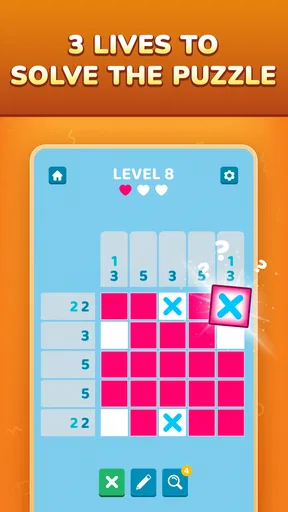
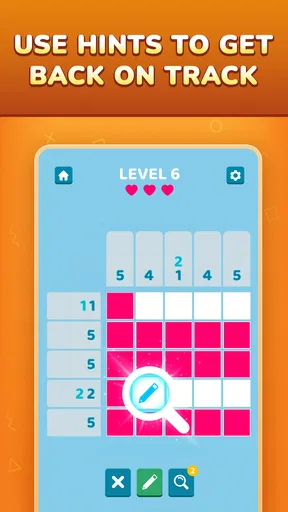
Nonocross is designed around logical deduction, so making a mistake can affect the rest of a puzzle. Depending on the selected mode or current version, the game may identify incorrect cells, allow you to undo moves, or provide hints when you are stuck. Progress is usually saved automatically, but it is still sensible to confirm that the game is updated and that your device has enough storage for reliable saving.
Play our best games!


